Friday, February 2, 2018

Indian Orchard Library


Originally known as Carnegie Library , it was built in 1908 with the help of a grant from  the Andrew Carnegie Foundation. The architect of the original building  was John Donohue. It opened officially in Mar 1909.  It's located on Oak st. on a corner lot facing also Worcester st. and is near the intersection with Main st.


The compound was extended  by  the addition on the Worcester st. side allowing for handicap patrons access and off-street parking in 2000.


It was always regarded as integral part of the village and it retained an air of independence from the city . Inside the original building the classical theme includes a ceiling dome.


The reading room is adjacent to it and with its relaxing atmosphere any reader will feel welcomed. 


Thursday, February 1, 2018

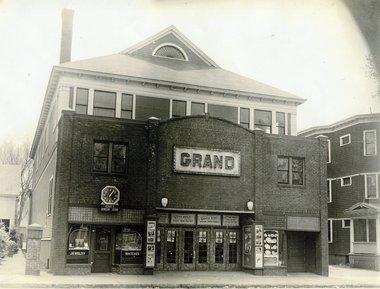
The Indian Orchard Grand Theatre

The Grand Theater on Main st. has been around since early 1900s.


1931 movie poster


The Great Depression hit movie houses everywhere


http://anotheroldmovieblog.blogspot.com/2010/04/grand-theater-indian-orchard.html

http://cinematreasures.org/theaters/10489


The Kamuda family ran the establishment that included Henry's Jewelry until the two
 were separated, with the jewelry business moving across the street.
 The movie house was bought and operated by Mr. Santos in the late 70s.
 Portuguese movies were shown then for the increasing Portuguese
immigrant community in I.O. and nearby Ludlow.


It operated as a movie house until mid 1990s.
 It currently houses religious services operating as a church..


The Jewelry store is still operating and is family owned by Barbara Kamuda.


Wednesday, January 31, 2018

Indian Orchard village history

Everywhere you look around Indian Orchard there's history. The street names recall the early trend of naming trees and functional directives such as elm or centre. Early settlers were also included in the mix. Montgomery and Healey to name some. The native tribal names can also be added, Pequot and Michigan are just some examples.
The story of the Indian Leap may not be unique to the village, but it has survived in local folklore in written and verbal forms.
The Chicopee river, which flows westerly past the aforementioned Leap, has been the heart and motor of the urban development of the village.


The river was dammed and partly diverted into a canal that has provided energy to the present day and allowed for the construction of the I.O. Mills.

http://www.indianorchardmills.com/

The employment opportunities in the mills allowed for exponential population growth.


Early employers did not have to worry about labor laws and child labor was practiced.


Until labor reforms were instituted nationwide, you could see that machine operators were very young .


The I. O. Mills helped build up the population which in turn needed schools for its children. 


The Myrtle street grammar school was built in 1868 and the building is still used
 presently as a senior housing project.


The 1900s brought most of the downtown area development and laying out
 the street map still in use today.

Main st. in 1907 still had horse buggies as the main private transportation. Public transportation between the village and the Springfield downtown  was possible through the cable  rail cars.